There are so many unknowns after an amputation. What will life be like? Can you find a new normal? Will you still be able to do the things you love, and will you still be able to try new things? While we can’t answer these questions for you, we can share what our patients have experienced, including their ups and downs.

Recovery from an amputation begins in the hospital but continues for much longer. Your residual limb or hand will likely swell, and you may experience varying levels of pain, phantom sensations or phantom limb pain. Every day will be different. When your pain eases one day but returns the next, that doesn’t take away from the relief you experienced. You had an easier day, and that’s great! When you find you can easily make a sandwich one-handed one day but struggle with it the next, that doesn’t erase what you accomplished. When you focus only on day-to-day changes, it can be difficult to see the progress. Zoom out a bit. What can you accomplish this week that you couldn’t do last week? What felt difficult last month but feels easier now? Our patients who recognize small victories and maintain perspective often find recovery more manageable.

The same principle applies when you first begin using your prosthesis. Progress will not be linear. When our clinical therapy specialists begin teaching patients to use their prostheses, they often see a great deal of excitement. Patients tell us over and over that they “cannot wait to get home and see what they can do now.” Our therapists also remind patients that frustration is a normal part of the learning process. We encourage you to try your prosthesis and use it as much as your initial wear schedule allows, but expect some frustration along the way. It makes sense! It’s a new and often complex tool, and learning to use it effectively takes time. Just because you were able to don your prosthesis and complete your tasks yesterday without any setbacks doesn’t mean today will go as smoothly. When we ask patients what advice they would give someone beginning their prosthetic journey, one message comes up again and again: “Be patient with yourself and with others.”

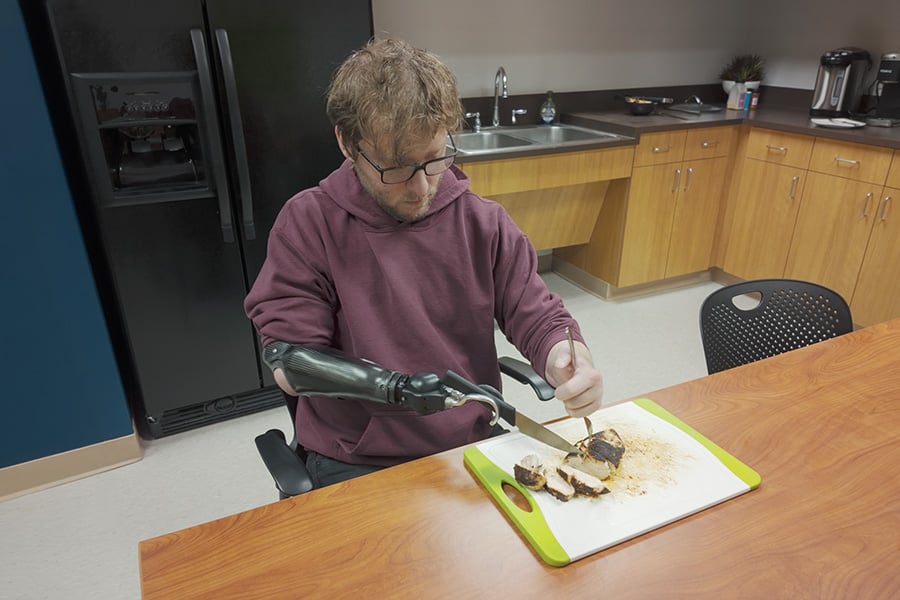
Arm Dynamics patient Chris learning how to use a knife to cut meat using his ETD prosthesis.

Another helpful tip is to start by using your prosthesis for one task. You don’t necessarily need to wear it all day and learn how to do all your daily tasks at once. For someone with a higher-level amputation, this approach can make it easier to focus on using each component of the prosthesis, including the terminal device, wrist, and, when applicable, elbow. This helps you recognize progress over time. By focusing on one task, you can work toward mastering it before moving on to the next. Instead of focusing only on becoming proficient with your prosthesis overall, you can mentally mark that task as “achieved” and take pride in it, even as your next task frustrates you.

Some of our patients stop thinking of themselves as being in recovery once their surgical wounds have healed. However, recovery can continue long after physical healing. Being cleared for prosthetic fitting or to return to work doesn’t necessarily mean your recovery is complete. You went through a traumatic event. Its effects may last for months, years, or even a lifetime. Life may not return to exactly how it was before. But that doesn’t mean you can’t experience happiness, joy, or progress. It may mean readjusting. Some patients find the concept of “Spoon Theory” helpful, which you can read more about in our article on the subject. As you adjust to your new normal, you may need to scale back on your everyday plans and goals.

If possible, connect with someone who is at a similar stage of recovery or has a similar level of amputation. If that isn’t possible, watch or read their stories to learn about their challenges and victories. Recovery takes time, but many of our patients have achieved remarkable things and built fulfilling new routines. Most are back at work, and some are raising children. We work hard to help every patient pursue their goals with a prosthesis that meets their needs. Connecting with peers who face similar challenges can help patients see that their own obstacles are manageable.

Madee and Ashley 900 x 600

Our prosthetists, prosthetic assistants and technicians work together to ensure each patient receives a comfortable, functional prosthesis that also meets their aesthetic preferences. Our clinical therapy specialists teach patients how to use their prostheses and communicate patient feedback to our prosthetists, who use it to make adjustments during the fabrication of each patient’s take-home prosthesis. This is part of our holistic care model, which emphasizes treating each patient as a whole person and supporting them through the ups and downs of recovery. If you would like to learn more about our care model and how to schedule a consultation, please contact us. You are also welcome to leave a comment regarding this article below.

Subscribe!

No Comments Yet

Let us know what you think