
In July 2015, Gerry went to work as a lineman, just like he had every workday for the past 20 years. On this day, however, his fingertip brushed a live line, and the next thing Gerry knew, he was in the hospital, missing both his arms from the elbows down.

While Gerry recovered in the hospital and later in the burn unit, his wife, Denice, was, of course, going through a tremendously difficult time. Denice recalled: “That man leads such a busy life, working and then running our farm, where we live. I thought, 'How will he go on without the use of his arms?'” Denice went online to learn about prosthetic options, and connected with our patient, Jason, a bilateral amputee who also lost his arms because of an accidental electrical shock. Gerry picks up the story: “Denice came to me, so eager to tell me about this phone call she’d just had. She said she’d called Jason, and the first thing he said was, ‘Hang on a second, I’m driving, let me pull over so we can talk.’ That was so good to hear, for the both of us – that he was driving as a bilateral amputee. And not only driving, but was happy to chat with Denice, and later me, and offer all the advice he could.” That was just one of the gifts Denice and Gerry received.

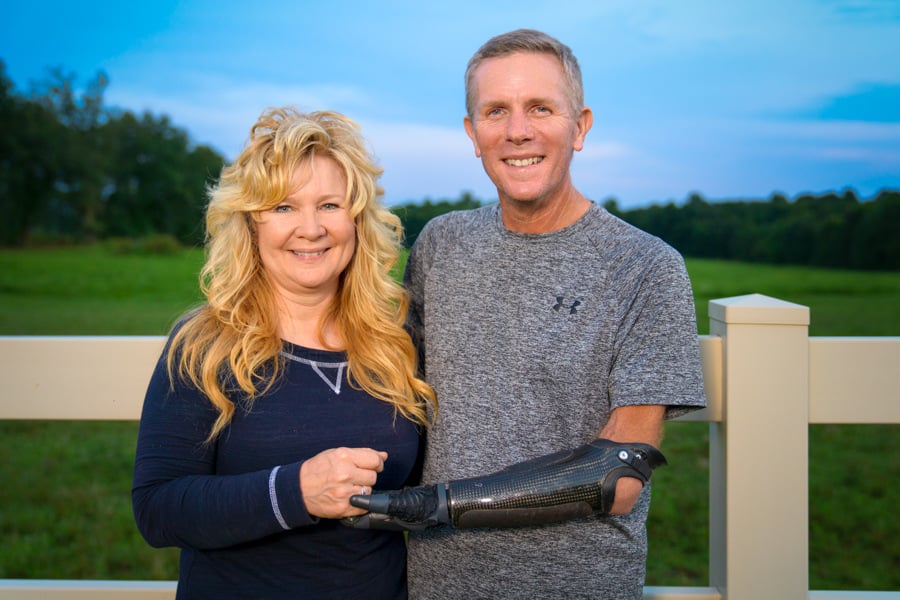
Jason was also the one who suggested that Gerry should go to Arm Dynamics for his prosthetic care. Denice: “He said, ‘You can go anywhere you like. It's your decision.’ But he also said, ‘It'll save you a lot of frustration, unnecessary expense and aggravation if you just go straight to Arm Dynamics.” After all, having worked with a general prosthetist for a couple of years, Jason knew that it was important for Gerry to find an upper limb specialist. Soon, Denice was on the phone with Julian, Gerry’s prosthetist-to-be. “Julian said, ‘Denice, we will get Gerry back to life and he will be doing everything he did before. I can tell you he will be able to do everything.’ I had cried so many tears by then, but this was the first time I cried happy tears since Gerry’s accident.” Gerry and Denice are pictured below.

GerryandDeniceKinney

Some people with an upper limb difference don’t even need to meet or chat with a new amputee to give them a gift. Our patient, Faith, has a congenital limb difference and found herself limited by the two prosthetic devices she had, a body-powered prosthesis and a custom silicone restoration. “I follow this woman named Angel Giuffria [also an Arm Dynamics patient] on Instagram. I remember finding her for the first time and learning she was also a congenital amputee and then following her and just being in awe about her bebionic hand. I was in awe about all the things that she was doing, and I thought, oh my gosh, I would love that. And so, she was my inspiration to looking into myoelectric devices.” We heard a similar story from our patient Candice. She didn’t like wearing a prosthesis as a child, so she gave it up. As an adult, she started to see people on social media wearing really cool myoelectric devices, began to look into them, and now she has myoelectric fingers. So, you never know who you’ll be influencing when you post!

Lastly, we’ll tell you a story about Abram and Angie. Abram was injured at work in late 2019, losing his left hand and wrist. Abram was devastated but soon found himself inspired to move forward by a documentary that features the limb loss story of Eduardo Garcia, an upper limb amputee and a chef. After watching it, Abram decided to post about his life without a hand on Instagram.

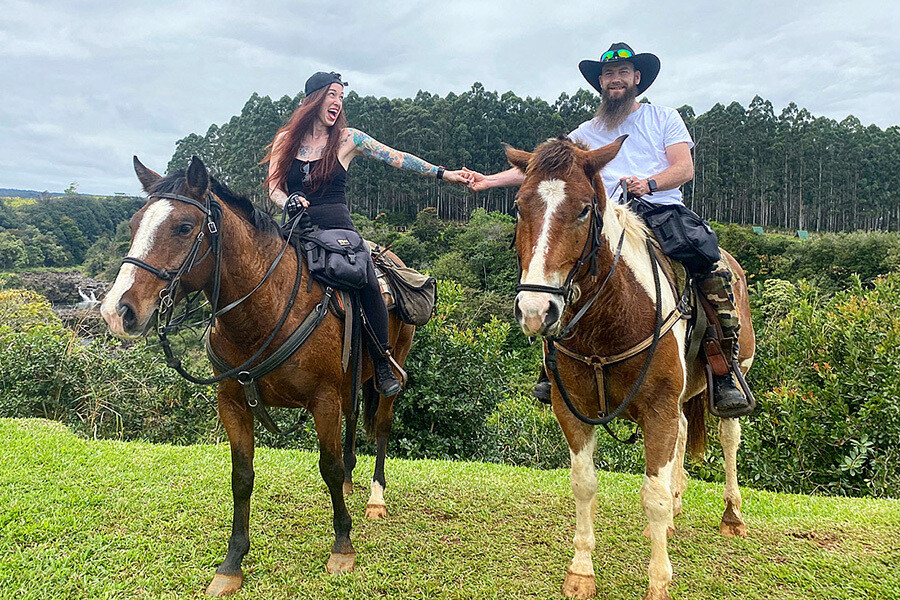
In early 2020, Angie was injured in an off-roading accident, losing her pinky, ring and middle fingers and part of her palm. We’ll let her take it from here: “It was a very long and painful recovery process, but I knew I needed to stay positive. I’ve always been a naturally positive person, but this kind of positivity took hard work and dedication. I knew I had to talk to someone that knew what I was going through. Of course, everyone in my life was there to support me, but none of them truly knew my struggles. I needed relatability. So, I took to social media. I started searching stuff that I had never even thought of searching before. Most of the ‘hashtag amputee’ posts that I found were lower limb amputees. I felt like that was kind of relatable but not what I was searching for. Then I stumbled across Abram. I saw that he was a full hand amputee, so I decided to reach out and send him a message. I don’t even really know what I was looking for in messaging him, but I just wanted someone that I could share stories and experiences with and also get advice from since I was so new to this amputee thing. He messaged me right back and even before reading his message I felt a sense of security. As we chatted, I found out that he lost his hand only 16 weeks before me in a terrible work accident. I instantly felt a connection to him. As I lay in bed in pain we chatted back and forth multiple times a week. He was a busy man but always found time to reach out to me to check in and see how I was doing. I think we helped each other. I realize that now because I always reach out to new amputees and not only am I helping them, but in doing so they help me just as much. The amputee community is truly amazing.” Abe and Angie are pictured below.

Abe and Angie

So many of us just want to be seen. In a positive way. The comments from strangers, such as, “What a cool device!” are nice, but they are not the same as connecting with someone who truly understands what you have been through and what you are going through. Every time an amputee is available to connect with others, or posts about their journey on social media, it can make such a big difference to others – sometimes many others! The chain of help and inspiration can just keep going: Eduardo helped Abram move forward, Abram helped Angie and now Angie is an ambassador for Point Designs, a prosthetic device company, in a role that allows her to connect with others with limb differences.

Knowing our patients are there for each other is something we absolutely love. We also love being able to provide them with prostheses that are comfortable, functional and look exactly the way our patients want them to look. Our prosthetists want to help their patients reach their goals, and our clinical therapy specialists want to teach their patients how to use their prostheses in a way that allows patients to reach their goals and helps them move their bodies ergonomically.

How can we help you? Please contact us to learn more. You are also welcome to leave a comment below.

Subscribe!

No Comments Yet

Let us know what you think