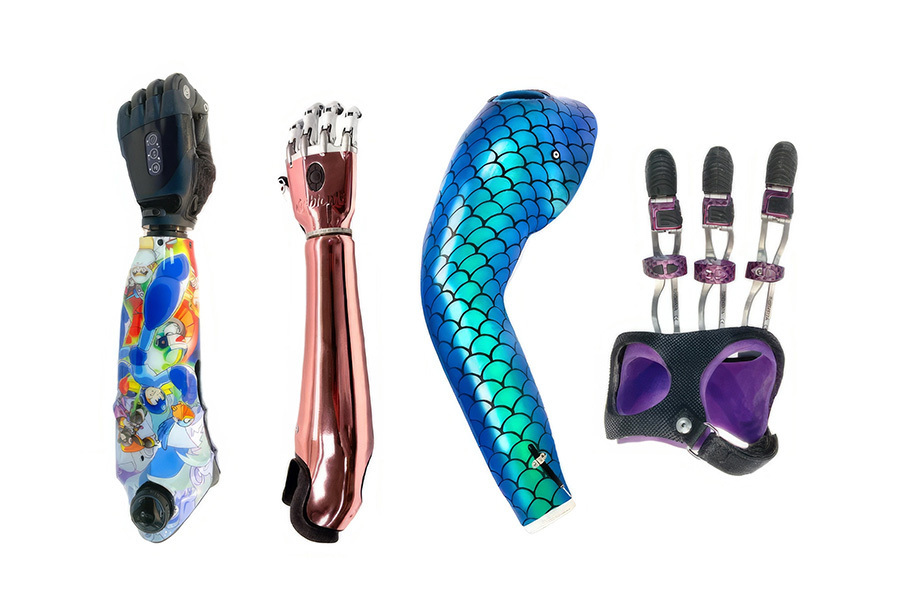
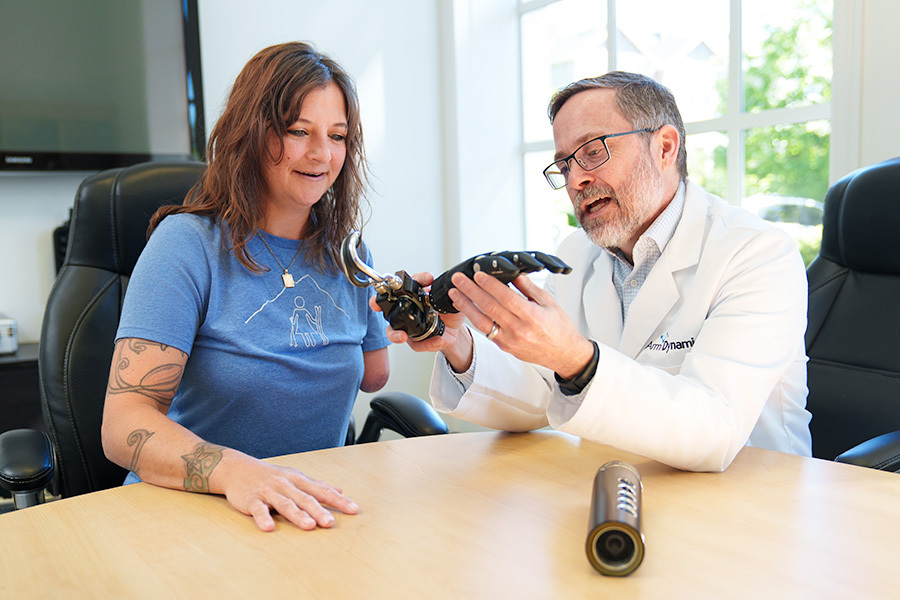
After an amputation, there are so many unknowns. “What will my recovery look like? What will I be capable of doing in a year? Will I ever be completely independent?” We can’t actually answer any of those questions for you, because everyone’s journey looks so different based on factors like amputation level, pain level, support and the person’s own drive. But we can offer you a look at what other people have been capable of doing with their prosthesis or prostheses. In fact, our Upper Limb Library offers a look into the prosthetic journeys of many of our patients.

How do we speak to people when they come in, to give them hope without raising their expectations too much? How do we let someone know that there is so much they will still be able to do while also being realistic with them about things that may no longer be possible, or at least take years to get back to? These are tough questions to navigate. Each of our prosthetists has had these conversations with their patients and their family members repeatedly over the years.

So, what is possible? Well, independence is possible. All the things that need to be done every day, that is, the bathroom necessities, dressing yourself, eating on your own and getting around – those are all called Activities of Daily Living. For people with higher-level amputations, or bilateral amputations, those can seem daunting to do on their own. But we know it’s possible because we have seen it over and over.

Arm Dynamics patient Rachel using her prosthesis to hold a fork while cutting meat with her sound hand.

There’s a second level, called Instrumental Activities of Daily Living. These include more complicated tasks, like meal prep, household chores and cleaning, and driving or using public transportation. Those may seem intimidating as well, but they are tasks nearly all of our patients have mastered, regardless of amputation level.

What’s necessary for all the above things, and other tasks, is drive and the willingness to be frustrated and fail. Over and over. Our patients who are the most successful are the ones who are not worried about making a mistake, about not getting a task right the first (or 20th) time. Our clinical therapy specialists tell their patients all the time that they will spend many of their first few months, if not longer, feeling frustrated about having to relearn a task with their prosthesis. But the ones who succeed are, funnily enough, the ones who are willing to fail. Our Portland center prosthetist, Mac: “We tell our patients that getting your independence back will require hard work. And people will say, well, I’m a hard worker. But the problem is, oftentimes, when people think of hard work, they think that more effort equals more outcome. But that’s not really what is needed when it comes to learning how to use a prosthesis, or prostheses. It’s practice and patience and allowing yourself to make mistakes. You can’t just put a lot of work in for a certain amount of hours and expect XYZ results – it’s far more complicated than that, and you also can’t overdo it.” But, with time, we have seen our patients accomplish truly remarkable things.

So, what isn’t possible? Well, the technology to have individual control over each finger isn’t quite there yet, though it’s getting closer. The ability to feel, have that touch sensation – we’re not there yet. You also can’t control a prosthesis with your “mind” yet – though myoelectric devices make the movement so instantaneous that it’s pretty darn close. There are some jobs we can’t return people to: concert pianist, surgeon, sign language interpreter. The really fine motor skill stuff can be tough. But jobs where you use your hands? Yes, people have returned to those positions: chef, repairman, mechanic, artist.

Arm Dynamics helped Mike get back to work as a air-conditioning repairman with his body-powered hook prosthesis

The job of our prosthetists isn’t to provide people with false hope or to be a Debbie Downer. Their job is to figure out what your goals are and then make those their goals. Mac, again: “If a patient comes in and they want to get back to some extremely difficult task, we need to look at it together, as a team. There are times when we decide together that a specific task will not be reasonable to do with a prosthesis, but those are the rare cases. More often the conversation becomes a discussion on how we think the person will be able to accomplish that task. Part of the equation is accepting that it will look different than how they’ve done that task in the past, and it’s usually a combination of the prosthesis, training, and setting the task up to make it successful. It takes time and we will work alongside them as long as it takes. Sometimes a person just needs to know they can do something. Then they can decide if the effort is worth the result on a daily basis. People change and new interests come up and we work with all of it. We work with the individual to figure out how to match what they want with the technology that is available to us – which is improving all the time. In my 20 years as a specialist, I have seen huge improvements in upper limb prostheses, and in the ability for people to access those improvements.”

So how much can an upper limb prosthesis do for you? The answer is a lot – it can let you regain your independence and do an incredible number of tasks. The answer is also – it’s not a biological hand. The answer is, additionally – you get out of it what you put into it.

Many of our patients succeed because we give them the tools, the skills, the support and the time that is necessary to be able to really thrive. We know that just fitting you with a prosthesis and sending you on your way is not how to develop a proficient prosthetic user. Patients need to be listened to, taught how to use the device for the tasks that are relevant to them, their prosthesis needs to be adjusted and they need to know that there are esources available to them, like mental health care. That is why we offer all those things as part of our holistic prosthetic care. If that is the kind of prosthetic care you would like to learn more about, please connect with us. You are also welcome to leave a comment below.

Subscribe!

No Comments Yet

Let us know what you think